Contract & SLA Copilot - Agentic RAG for Service Operations
An internal AI copilot that answers contract and SLA questions with cited clauses and a human check before anything reaches the customer, taken from use-case selection to a costed business case, an MVP design and a working mini MVP.
Team projectGenerative AIAgentic RAGBusiness caseProduct managementAI governance
Context: capstone of the MBA course Generative AI for Managers at TUHH / NIT Hamburg (see the course notes) · Team: Team NIT26-1, three members (Ana, Jenny and Ravi) · Delivered: a proposal pack, a 12-slide pitch with a recorded 10-minute video, and a mini MVP built in Python and Streamlit.
37 → 6 minhandling time per contract query, as-is versus to-be
84%less time per query
€133,865likely annual value (range €66,500 to €250,750)
€38-55KMVP investment, with payback in year one
21 / 25prioritisation score: the highest of the use cases assessed
15 casesgolden set used to evaluate the working mini MVP
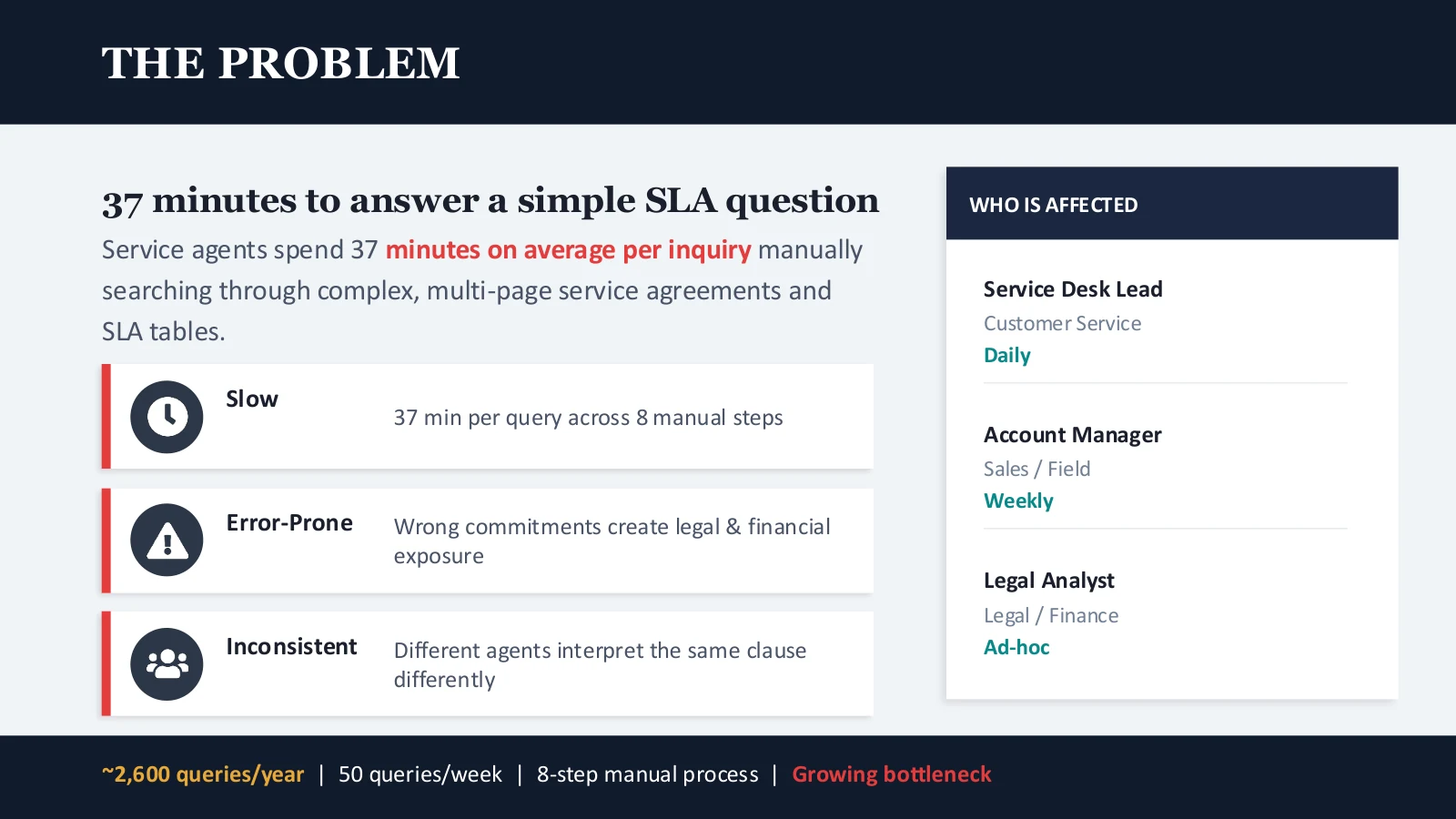
Service desk agents answering customer questions about contract coverage, SLA response times or service credits spent about 37 minutes per query, searching long agreements, appendices and amendments across several systems. The process was slow, agents read the same clause differently, and a wrong answer creates legal and financial exposure.
What we designed
A copilot panel beside the support ticket. It structures the question, retrieves the relevant clauses from the contract repository, drafts an answer with clause-level citations and a confidence signal, and routes ambiguous cases to a contract specialist. An agent reviews every draft before it is sent.
The team's work
Working as a team of three, we took the idea through the full course framework: use-case selection and prioritisation, as-is and to-be process maps, value sizing, a product requirements document, architecture, a build-or-buy decision, governance, a 30/60/90-day rollout, KPIs and the pitch, and then a working mini MVP to prove the core flow.
The outcome
A fundable proposal: handling time from 37 to about 6 minutes, a likely annual value of €133,865 against an MVP cost of €38,000 to €55,000, and a controlled pilot with clear go and no-go gates, all backed by a live demo that answers with citations and escalates when unsure.
Slide from the team’s pitch: 37 minutes per query, across an eight-step manual process.
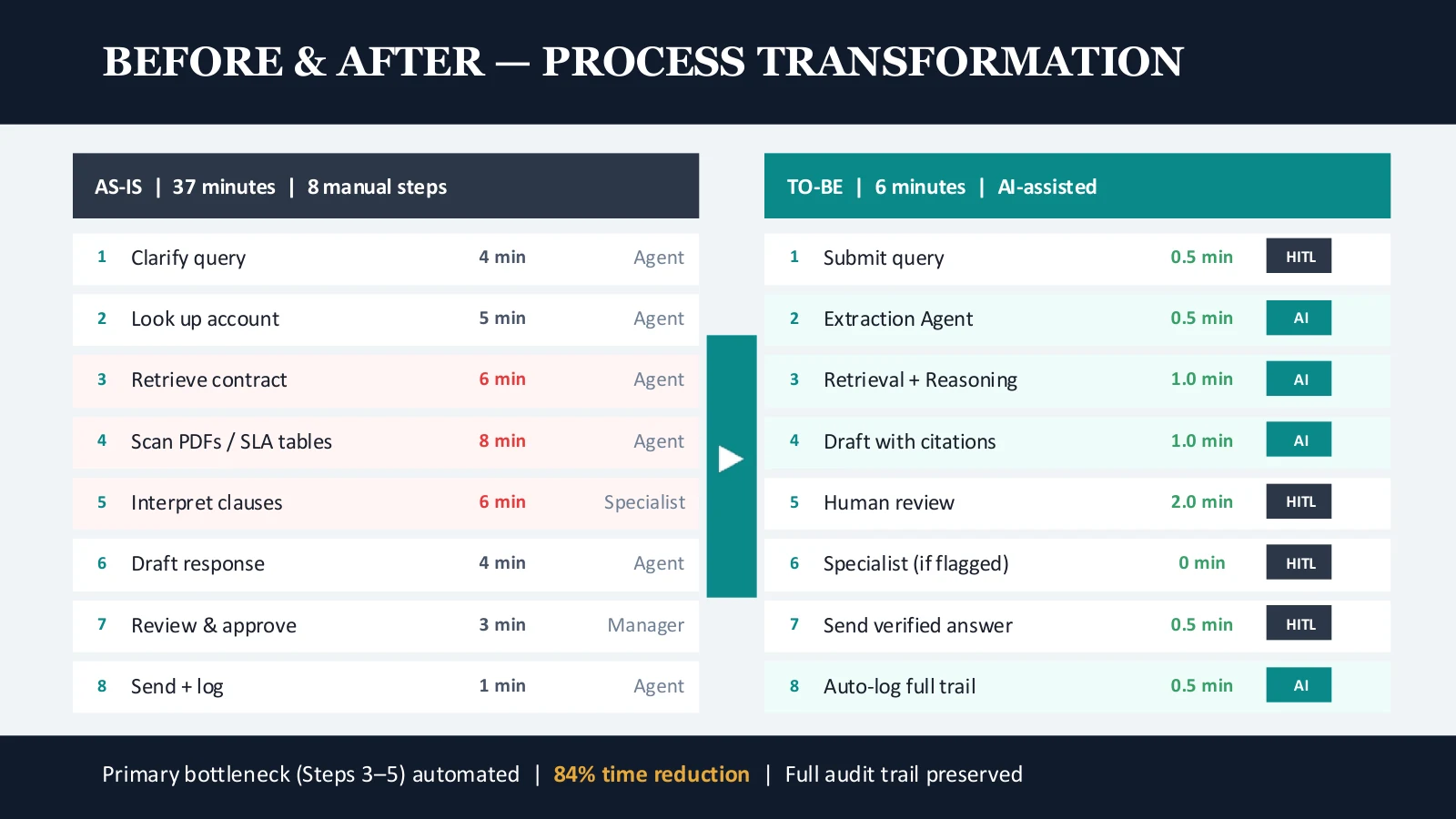
The as-is and to-be process maps: the bottleneck of finding and interpreting clauses is automated, and the human review stays.
The as-is process map showed where the 37 minutes went. Three steps, retrieving the right contract version, reading the PDFs and SLA tables, and a specialist interpreting the clauses, took 20 minutes between them, more than half of the total. That is the work GenAI is good at, and the work the copilot takes over.
Step (as-is)
Who
Time
Clarify the query
Service agent
4 min
Look up the customer and contract context
Service agent
5 min
Retrieve the contract, SLA appendix and amendments
The course asks for a complete Capstone Proposal Pack, built in four blocks. We followed it end to end.
Choose the right use case (Block A). We screened candidate use cases for fit and scored them on value potential, time to value, feasibility, risk and evaluability. The Contract & SLA Copilot scored 21 out of 25, a strategic bet on the course’s value versus time-to-value grid (high value, needing careful planning and executive sponsorship), with evaluability as its strongest point: every answer can be checked against the clause it cites.
Map the process and size the value (Block B). An eight-step as-is map (37 minutes) and an eight-step to-be map (about 6 minutes) gave a saving of 31 minutes per query. At 2,600 queries a year and a loaded cost of €55 an hour, that is €73,865 in time alone, and €133,865 once avoided SLA penalties and rework are added.
Specify the MVP (Block C). A product requirements document defined the job to be done, three in-scope features, eight explicit non-features, five user stories and five testable acceptance criteria. The architecture sketch, the build-or-buy table and a governance-lite checklist completed the design.
Plan the rollout and the safety net (Block D). A 30/60/90-day plan with go/no-go gates, 11 KPIs across adoption, efficiency, quality and business outcome, a pre-launch evaluation on a 100-case golden set, stop-and-fix triggers and a kill switch.
Pitch it. A 12-slide deck and a recorded 10-minute pitch, structured as problem, why now, MVP, value, plan and the ask, leading with the business problem rather than the technology.
Prove the core flow. A mini MVP in Python and Streamlit that answers questions over a small set of contracts with citations, confidence and escalation, and evaluates itself on a golden set.
Turns the customer’s question into a structured query, with the contract or customer, the SLA topic, the service type and the relevant asset, so the right contract is found first time.
F2 · Clause retrieval with citations
Semantic search finds the relevant contract sections and returns clause snippets, clause identifiers and document references, so every answer is grounded in real text.
F3 · AI draft with human review
Drafts a customer-ready answer with citations in a panel beside the ticket, where the agent can accept, edit or reject it. Nothing is sent automatically.
Just as deliberate was what the MVP would not do: send answers automatically, support several languages, integrate fully with the CRM, transcribe calls, edit contracts, predict SLA breaches, run on mobile or offer analytics dashboards. Keeping the scope this tight is what made a four-week MVP realistic.
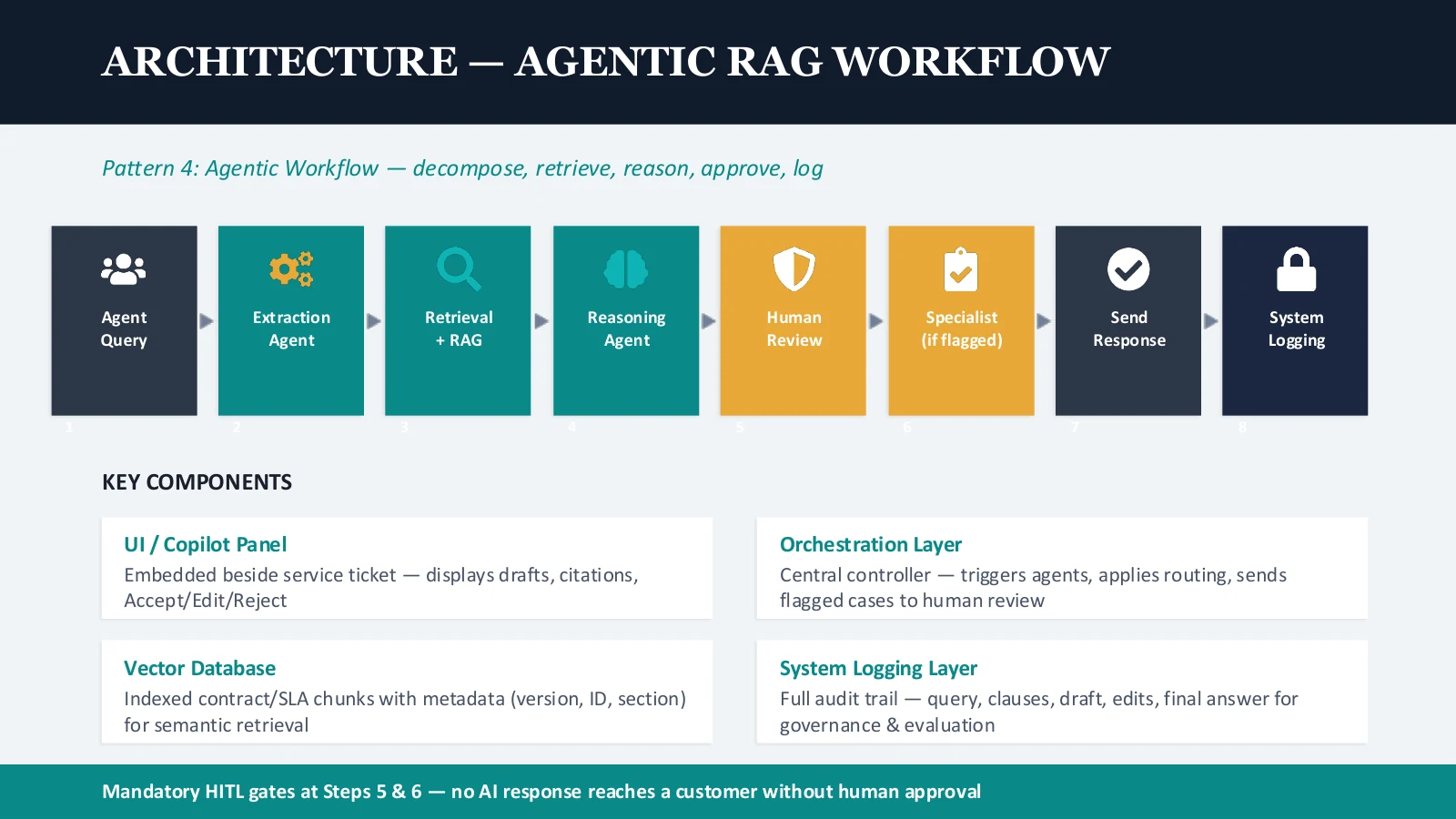
The agentic RAG workflow from the pitch: decompose, retrieve, reason, approve, log.
Agent asksin the copilot panel
→
Extraction agentintent and entities
→
Retrieval agentclauses from the vector store
→
Reasoning agentcited draft, confidence
→
Human reviewaccept, edit or reject
→only if flagged
Specialistambiguous clauses
→
Send and logfull audit trail
Two human approval gates: the agent always, the contract specialist whenever the system flags ambiguity.
Component
What it does
Copilot panel
Sits beside the service ticket; shows the draft, the citations and the confidence flag, with accept, edit and reject
Orchestration layer
Triggers the agents in order, applies the routing rules and sends flagged cases to a person
Extraction agent
Turns free text into a structured query: customer, SLA topic, entitlement type
Retrieval and reasoning agent
Searches the vector store and drafts an answer grounded in clause-level evidence
Vector database
Indexed contract and SLA chunks with their version, ID and section
Indexing layer
Ingests, chunks and indexes approved contracts in the background, read-only
Logging layer
Records the query, the clauses used, the draft, the edits and the final answer for audit and evaluation
Build or buy? We recommended a hybrid: buy the commodity infrastructure (document indexing, vector database, LLM inference) to hit the four-week timeline, and build the intelligence layer (query extraction, contract-specific reasoning prompts, ambiguity detection), because generic copilots lack the clause-level precision and citation grounding that legally sensitive commitments need.
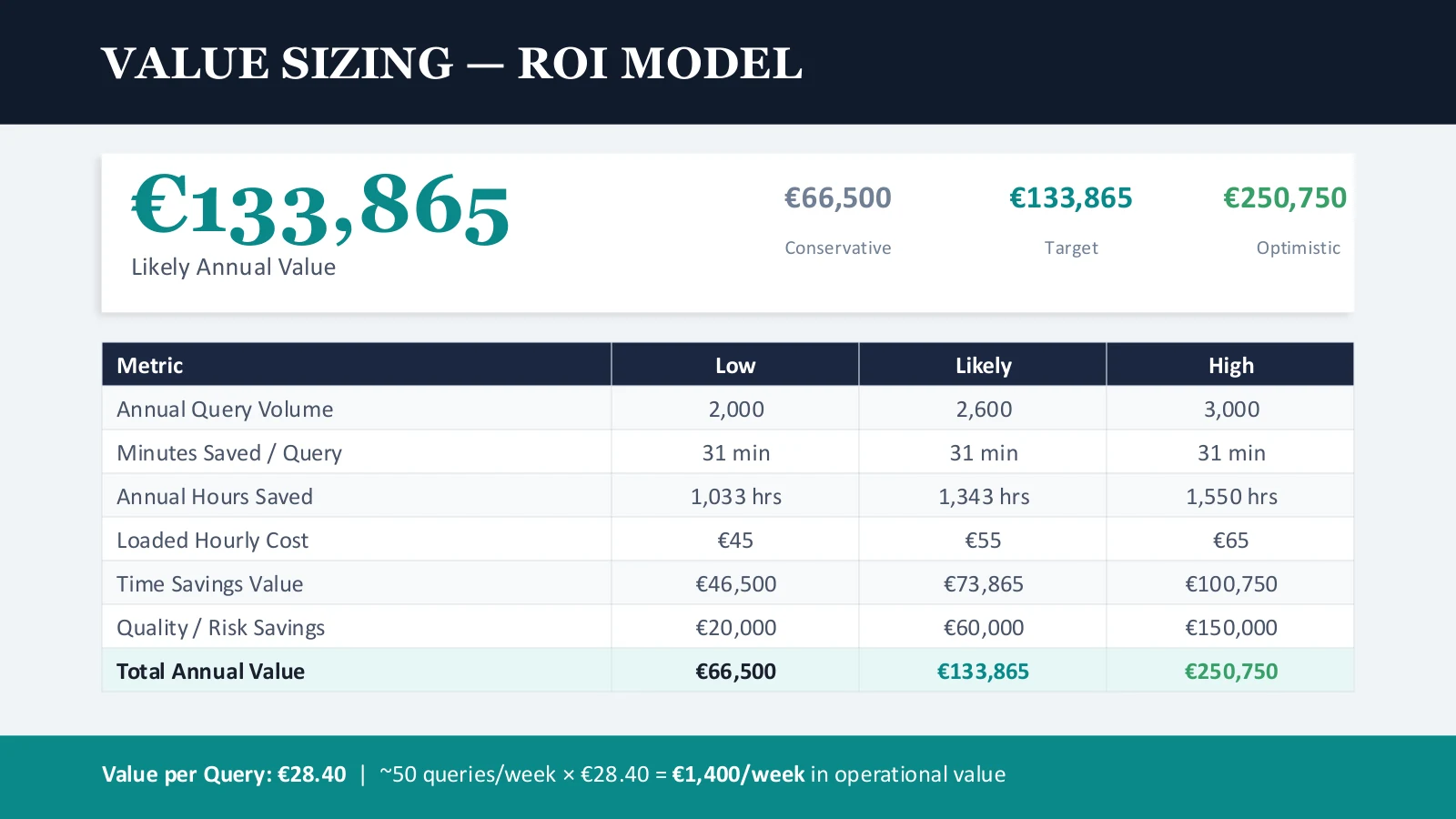
The value-sizing model from the pitch. Every figure traces back to the process map and a stated assumption.
Conservative
Likely
Optimistic
Queries a year
2,000
2,600
3,000
Minutes saved per query
31
31
31
Hours saved a year
1,033
1,343
1,550
Loaded hourly cost
€45
€55
€65
Value of time saved
€46,500
€73,865
€100,750
Avoided penalties and rework
€20,000
€60,000
€150,000
Total annual value
€66,500
€133,865
€250,750
Against an MVP investment of €38,000 to €55,000 (infrastructure €8-12K, four weeks of development €25-35K, pilot monitoring €5-8K), the copilot pays back within its first year. Each query handled with it is worth about €28 in freed time.
No AI answer reaches a customer without an agent’s review. Ambiguous or high-impact cases go to a contract specialist.
Data and access
Contracts are confidential: they stay in the approved cloud tenant, access is by single sign-on and role, and every session is tied to a user.
Evaluation
A 100-case golden set from historical tickets (40% coverage, 30% SLA, 30% credits, edge cases included), reviewed blind by contract managers. The pilot starts only at 85% answer accuracy and 90% citation grounding or better.
Stop and fix
The rollout pauses automatically if accuracy falls below 85%, citation grounding below 90%, the override rate rises above 25%, latency exceeds 90 seconds, or any serious data leak occurs. The product owner and the service operations lead hold the kill switch.
Phase
What happens
Gate to the next phase
Days 1-30 · Pilot
10 tier-1 agents, coverage, SLA and credit questions only, one day of training, weekly reviews
80% adoption or more, zero data leaks, stable human review
Days 31-60 · Expand
All 50 agents, contract managers added, the top three pilot issues fixed
Resolution in 10 minutes or less, 85% accuracy, escalations under control
Days 61-90 · Scale
The copilot becomes the standard first step; ownership moves to service operations
ROI readout against the €73,865 time-savings target
To show that the core of the design works, a mini MVP was built and deployed. It runs the full operator flow, from question to evidence, answer, review, audit and evaluation, over eight short synthetic contracts, one of them an addendum that overrides its base contract, to test amendment handling.
Hybrid retrieval
Contract clauses are embedded and indexed with FAISS. Each hit is scored as 65% semantic similarity and 35% keyword overlap, and the top five clauses are passed on as evidence.
Grounded answers
An LLM, Google Gemini or OpenAI chosen in the app, drafts a short answer, a reasoning summary and citations with contract and clause IDs, using only the retrieved evidence.
Confidence and escalation
Confidence is calibrated against the evidence. Answers are escalated when confidence falls below 0.60, when the top clauses are too close to call, or when a question needs legal judgment.
Human review and audit
A review tab to accept, edit, reject or escalate each answer, and a log of every run: question, retrieved clauses, answer, citations and the reviewer’s decision.
Built-in evaluation
A 15-case golden set with expected answers and clause IDs. The evaluator reports answer accuracy, citation validity, clause overlap, groundedness, retrieval hit rate, escalation accuracy and latency.
Safe to share
No API key ships with the app: users paste their own key into the interface, and nothing is stored in the repository.
The demo’s own targets were 12 of 15 golden cases materially correct, 13 of 15 with a valid contract and clause citation, and an answer in under about ten seconds.
The hardest part of a GenAI business case is not the model; it is making the value believable. Anchoring every number to a timed process map made the €133,865 traceable, line by line, instead of a guess. Scope discipline mattered just as much: the eight non-features are what make a four-week MVP credible. And in a legally sensitive setting, trust has to be designed in, not added later, through citations on every answer, a human gate before anything is sent, escalation when the system is unsure, and a golden set that decides whether the pilot may go ahead at all.
Proposal pack: the use-case one-pager, process maps and value sizing, the MVP requirements, the architecture and build-or-buy decision, the governance checklist, the rollout plan with KPIs, and the pitch script.
Pitch deck: the 12 slides presented to the course, with links to the video, the mini MVP and the code on the last slide.