Project RE:CHARGE - Turnaround Strategy for CERMEDES
A strategy consulting engagement for a German power-tool maker that had lost its edge: from market and pricing analysis to a costed turnaround plan to 2030, an EU expansion roadmap and the project plan to deliver it.
Team projectBusiness strategyMarketing mixPricingInternationalisationProject management
Context: the MBA seminar Applied Market & Business Strategy at TUHH / NIT Hamburg, run as a management game (see the course notes) · Team: Group 4, six members, acting as the consultancy hired by the new CEO · Delivered: a 48-page strategy report, a seminar’s worth of case exercises and a topic presentation on routes to foreign markets.
€30.7Mrevenue of a company with flat and declining sales
4Ps + 3product, price, place and promotion, plus three enablers
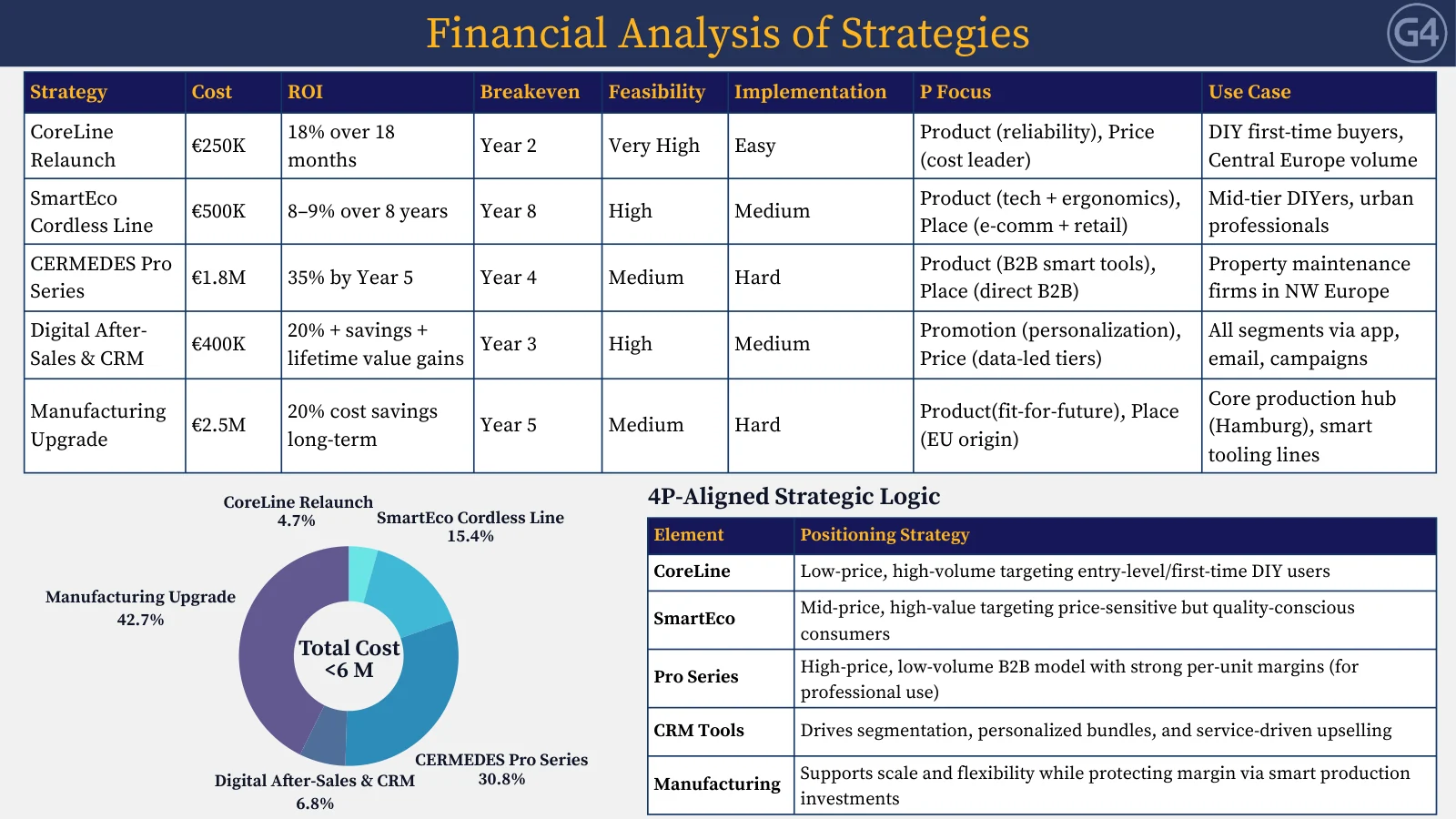
5 pillarsinvestment plan, under €6M in total
10 marketsoutside Germany, sequenced to 2030
25%target share of sales from outside Germany by year 5
48 pagesfinal report, with charter, WBS, Gantt chart and risk register
CERMEDES, a Hamburg maker of durable corded DIY power tools with 85 employees, was a trusted local brand facing flat and declining sales. Its portfolio missed the shift to cordless and smart tools, 70% of its revenue went through wholesalers, it had no web shop or customer data, and its pricing did not communicate its quality.
What we did
As the consultancy hired by the new CEO, we worked the case end to end over the seminar: industry and competitor analysis, SWOT and resource analysis, segmentation and personas, pricing and profitability, international market selection, a pitch, and finally a full strategy report with a project plan.
Our recommendation
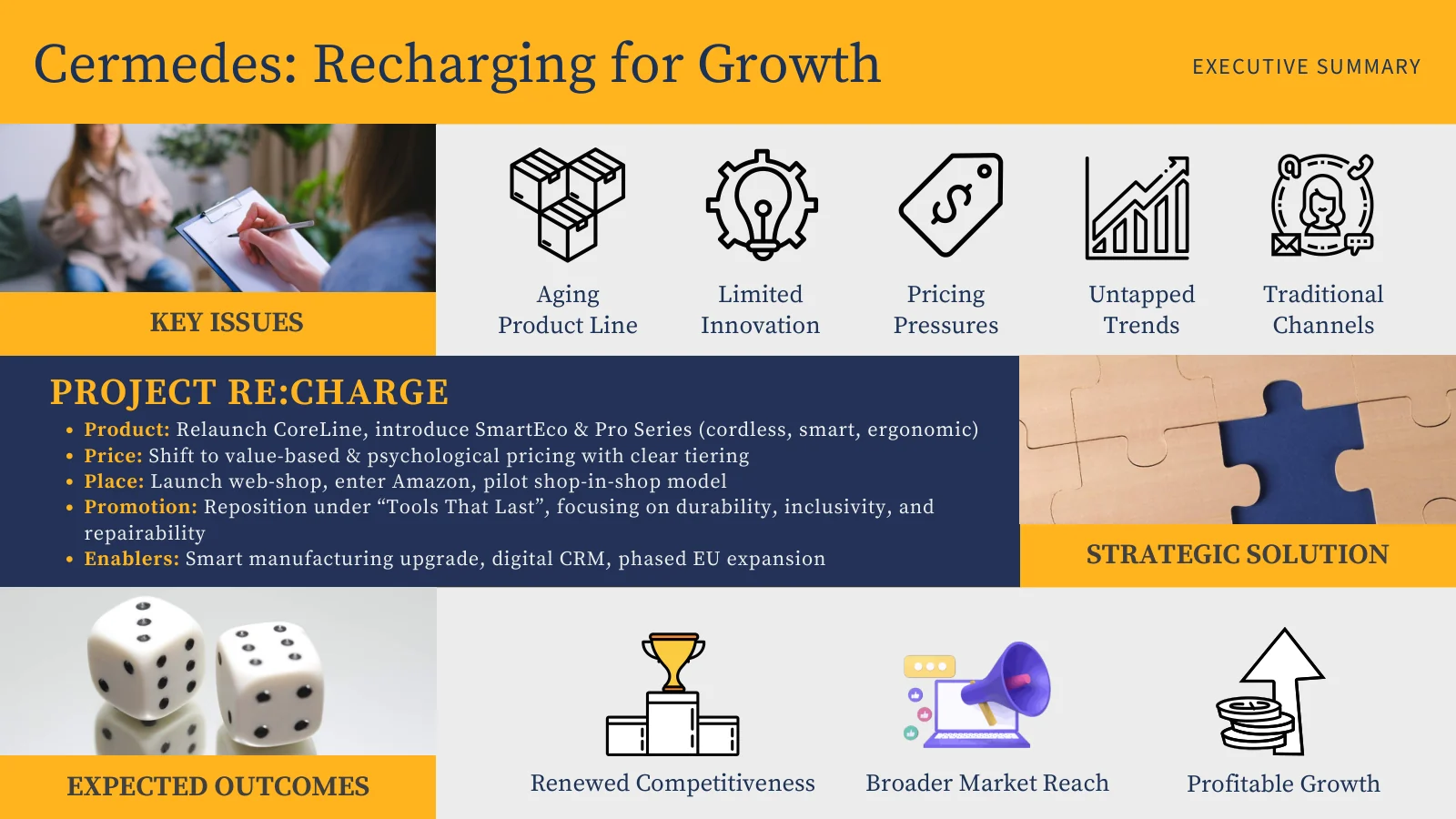
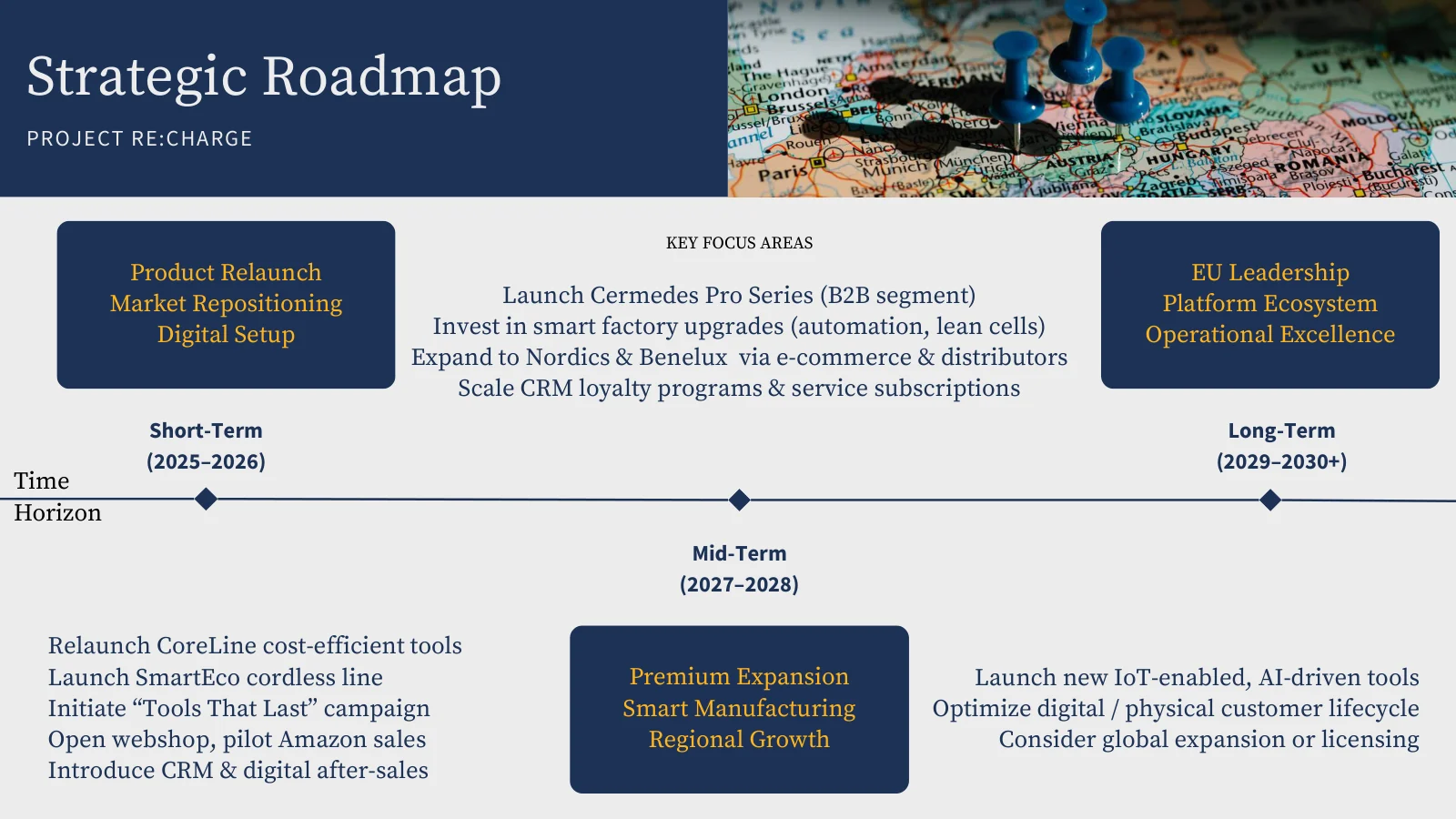
Project RE:CHARGE: modernise the portfolio with cordless, smart and ergonomic lines; move to value-based, tiered pricing; add direct online channels; reposition the brand as Tools That Last; and back it with smart manufacturing, a CRM and a phased EU expansion.
The outcome
A costed plan in three horizons to 2030: five investment pillars under €6 million with returns and breakeven years, a country-by-country expansion roadmap, and a project charter, work breakdown structure, Gantt chart and risk register for the first two years.
High-quality corded DIY power tools: drills, hammer drills, grinders
Size
About €30.7M revenue, 85 employees (61 in production), one site in Hamburg producing about 480,000 units a year
Products
Corded only: no cordless line, no brushless motors, no smart functions, no shared battery platform
Prices
Mid-premium, €42 to €85 wholesale: above budget imports, slightly below the leading brands
Channels
70% of revenue through wholesalers, 30% through specialty retail; no web shop, no marketplace presence, no CRM
Market
German power tools growing about 3.7% a year to around $3.4 billion by 2031; cordless already about 81% of the market
The diagnosis. CERMEDES’ engineering quality and Made in Germany reputation are real strengths, but it was losing competitiveness on five fronts: an ageing product line, limited innovation, pricing pressure, untapped trends and dependence on traditional channels. It also overlooked growing segments, such as women DIYers, tech-savvy DIYers, older craftspeople and facility maintenance firms.
How we worked: the seminar as a consulting engagement
Situation analysis. Industry overview, trends and the competitive landscape, then SWOT with a TOWS matrix (SO, WO, ST and WT strategies), a 5C analysis and a resource-based (VRIO) view of what CERMEDES can build on.
Customers and value. Segment identification and selection, personas for the priority segments, a business model canvas, a product life-cycle assessment and a sharper value proposition.
Going international. A yes-or-no case for internationalisation, a market-selection process and an Uppsala-style rollout, prioritising markets in four waves: Austria and Flemish-speaking Belgium first, then the Netherlands and French-speaking Belgium, then Switzerland and Scandinavia, and France and the UK last.
Pricing and profitability. A product-by-product contribution analysis, the volume-versus-margin trade-off, what to do with loss-making products, and whether price increases are viable.
The pitch. Situation, problem and resolution for the CEO, leading with the business problem: declining sales, outdated technology and rising competition.
The final report and the project plan. The full RE:CHARGE strategy, its financial case and the plan to deliver it: charter, work breakdown structure, RACI, communication plan, Gantt chart, stakeholder matrix and risk register.
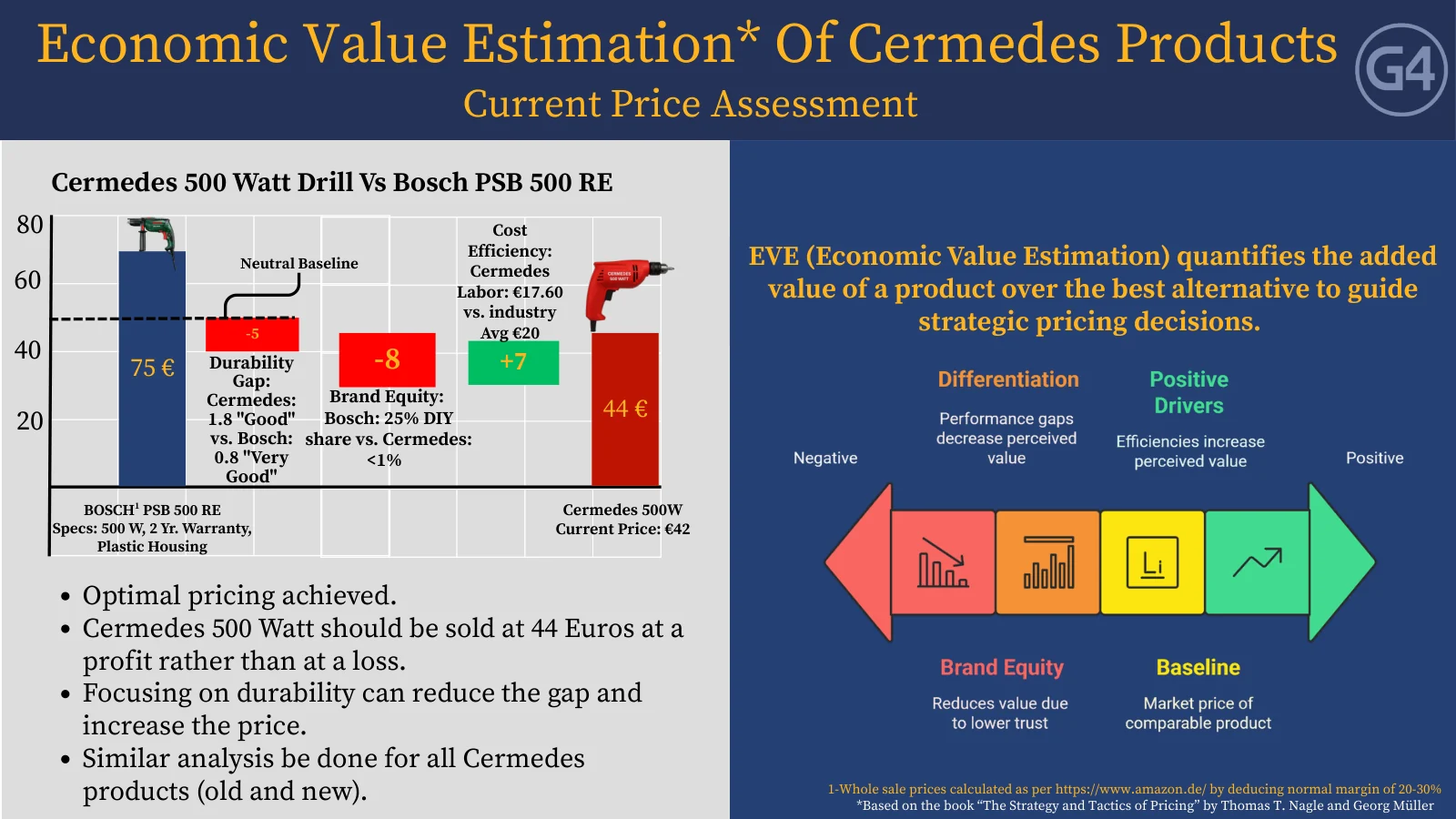
The contribution analysis showed CERMEDES was losing money on its cheapest tool: the 500 W drill sold at €42 against €43.06 of direct costs, a negative margin, while the 2000 W hammer drill earned more than €27 per unit (about 32%). An economic value estimation against a leading competitor’s equivalent drill put the value-based price at about €44, and a 5% increase on the top drill (€65 to €68 wholesale) could add about €300,000 a year in profit if volume held. The lesson: stop discounting the brand at the bottom and price the strong products on the value they deliver.
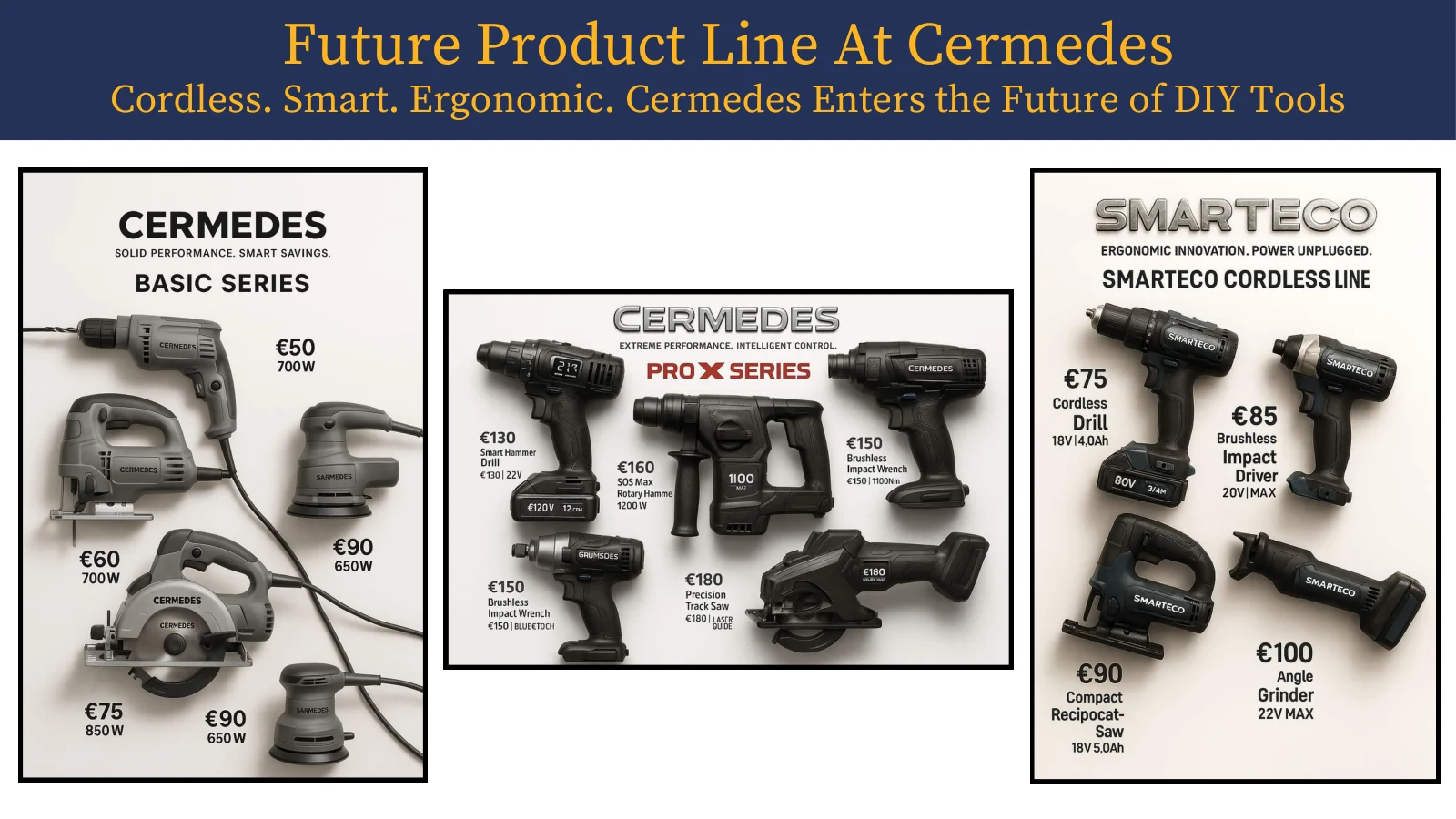
Relaunch a cost-efficient CoreLine, introduce the SmartEco cordless line through a cross-brand battery alliance, and develop a Pro Series of smart tools for professional users. Add ergonomic, lighter designs and phase out overlapping models.
Price
Move from cost-plus to value-based pricing with good-better-best tiers (Basic, Advanced, Pro X), psychological price points and bundles, cordless tools about 10% below the market leader, and no reactive price wars.
Place
Launch a web shop and Amazon presence, pilot shop-in-shop displays with large DIY chains, keep pro tools with dealers to avoid channel conflict, and set up a European logistics hub with a fulfilment partner.
Promotion
Reposition the brand under Tools That Last: durability, inclusivity and repairability, told digital-first through tutorials, influencers and real users, with marketing raised to 8-10% of sales and a 40/30/20/10 media mix.
Enablers
A hybrid manufacturing model (final assembly and motor quality checks in Hamburg, casings and batteries outsourced, automation at home), a CRM for customer data and after-sales, and a phased EU expansion.
Why it fits
It builds on what CERMEDES already does well, quality and German engineering, while closing the gaps that cost it customers: cordless, smart features, direct channels and a clear brand story.
The Pro Series targets a high-margin niche, property maintenance firms in north-western Europe, with co-developed cordless and diagnostic tools and multi-year supply contracts. A separate, more detailed roadmap for that sector to 2030 is costed at €3.6 million, with an average 25-30% return and breakeven in years four to five, aiming to make CERMEDES a top-three brand there. For SmartEco, the unit economics were worked out in detail: about €50.50 production cost against an €80 wholesale price, a 36.9% gross margin, and a breakeven of about 96,000 units a year.
The CEO had ruled out international growth for now, so the plan respects that: a year of internal readiness first, then expansion from late 2026 following the Uppsala model, starting in close, low-risk markets and moving outward as knowledge and commitment grow.
Amazon, local online retailers and agents, then distributors
Phase 3 · year 4 and later
France, the UK, Eastern Europe
Joint ventures or licensing, localised e-stores
The international programme is planned at €5.6 million over 2026-2030 with an average return of 24-30%, aiming for 25% of sales from outside Germany by year five. New tools launch and prove themselves in Germany first and reach other markets six to twelve months later.
Five targets, explicit non-targets (no immediate global expansion, no in-house battery development, no disruption of existing channels), seven deliverables, six key risks and the stakeholder map.
Work breakdown and schedule
A work breakdown structure in six work packages, from project management and manufacturing to product development, CRM and e-commerce, logistics and the brand campaign, with a Gantt chart for 2025-2026.
Roles and communication
A RACI matrix, team responsibilities per work package, a meeting and reporting plan, and a stakeholder matrix.
Risk register
Eight risks with root cause, impact, probability, mitigation and an owner, from construction delays and workforce concerns to CRM integration, battery-standard fit, data protection and campaign budget overruns.
Alongside the case, each group presented a topic. Ours was routes to foreign markets: a 55-slide presentation of how companies enter markets abroad, combining textbook entry modes, real examples and a systematic literature review.
The literature review followed a five-step systematic process: keywords, a Boolean search of Web of Science (3,738 articles from leading international business journals, 2014-2025), citation and usage filters (396 articles), relevance scoring down to 30 articles, and a content analysis. The most used theories were the Uppsala model, transaction cost economics, the eclectic (OLI) paradigm and the resource-based view, and one of the clearest research gaps was the limited attention to non-traditional entry modes.
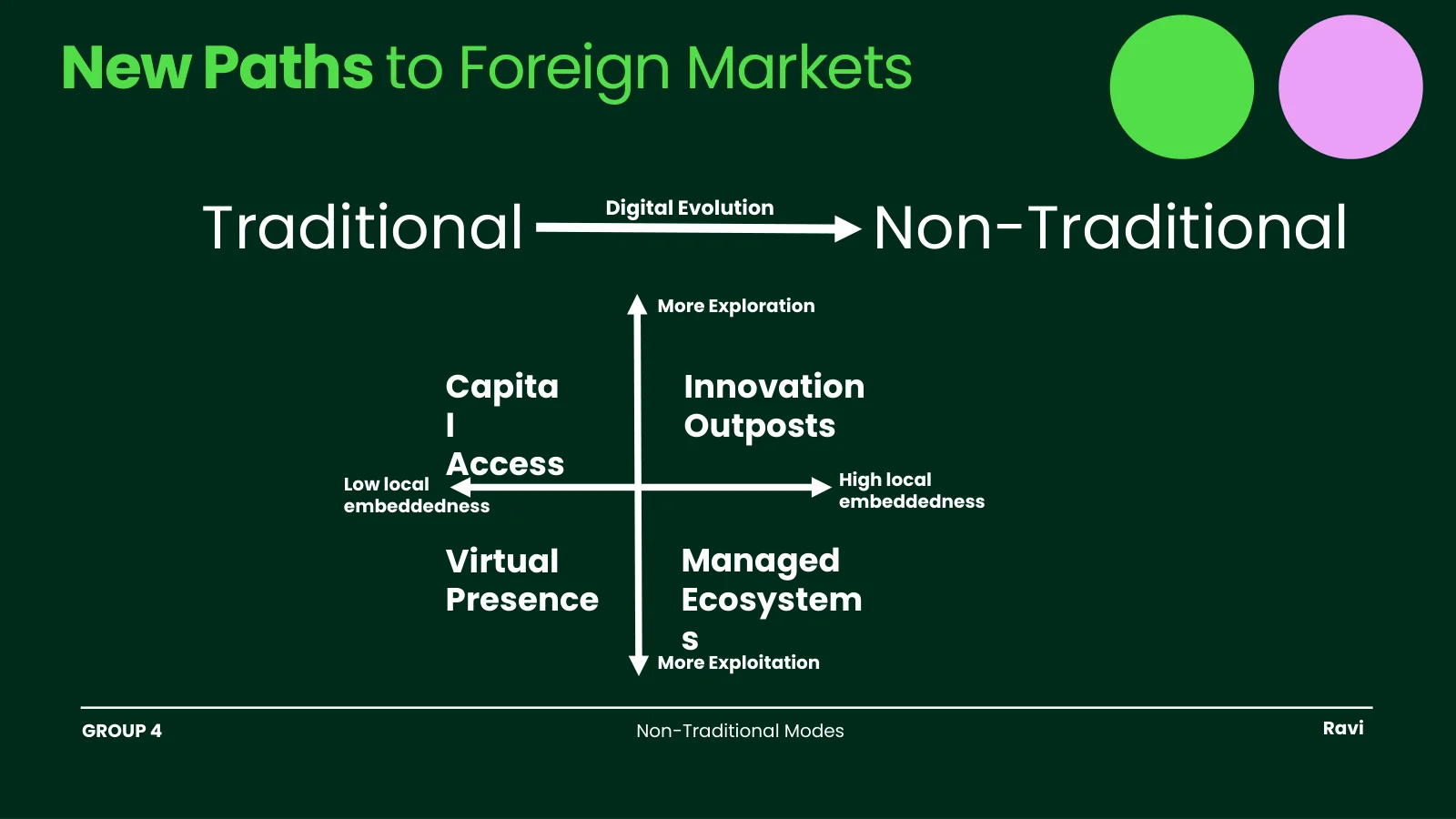
I presented the section that picks up that gap, based on Brouthers, Chen, Li and Shaheer (2022) in the Journal of International Business Studies. Besides exporting, licensing or building a subsidiary, firms can now enter a market in four less physical ways:
Capital access
Entering a market financially rather than physically: listing shares, issuing bonds or raising venture capital abroad. Low cost and low control, with no subsidiary needed.
Innovation outposts
A small team in a foreign innovation hotspot that scouts ideas and technologies through startups and universities. It enters to import knowledge, not to sell.
Virtual presence
Serving foreign customers purely online, through platforms and cross-border delivery, with no local offices, distributors or partners.
Managed ecosystems
Extending a multi-sided digital platform into a country so that independent local providers and customers transact on it, with no physical assets.
My framing slide: non-traditional modes by local embeddedness and exploration versus exploitation.
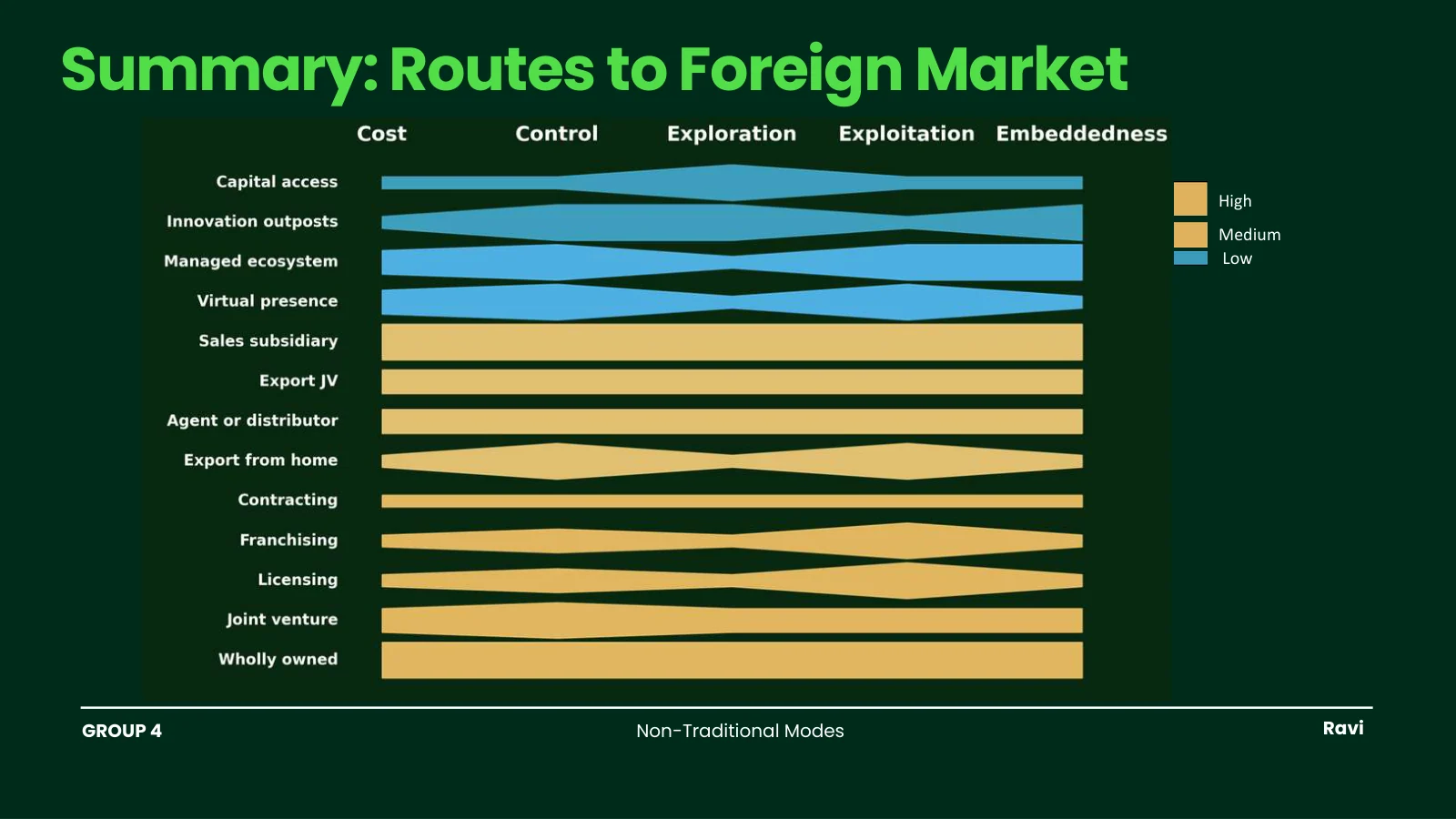
The summary comparing all entry modes on cost, control, exploration, exploitation and embeddedness.
The topic fed straight back into the case: the report starts CERMEDES’ internationalisation with indirect and non-traditional entry modes, such as multilingual e-commerce and marketplaces, before committing to local partners and assets.
Final report: the full RE:CHARGE strategy in 48 pages, from the market review and diagnosis through the 4Ps, the financial case and the international roadmap to the project charter, work breakdown structure, Gantt chart and risk register.
Class exercises: the team’s in-class work across the seminar, compiled in one file: situation analysis, segmentation, routes to foreign markets, internationalisation, pricing, the pitch and the project plan.
Foreign-markets presentation: the 55 slides as a PDF to view in the browser, or as the original PowerPoint.